The Margin Scissors & The Crude Trap: Navigating India’s New Volatility Regime
Tuesday, May 12, 2026 | IST Market Session Update
If you woke up this morning checking the Nifty 50 and felt a sense of impending dread, you weren’t alone. While the Indian markets often attempt to find their footing during the morning sessions, the global macro backdrop has just shifted from "uncertain" to "violent."
As we sit in the middle of the IST trading session, the story isn't just about rising oil prices—it is about a complex, cascading chain of events that is currently rewiring the profit margins of India’s biggest companies. From the refineries of Reliance to the jewelry showrooms of Titan, the shockwaves are moving through the economy in a way that most retail investors are likely to miss until the monthly NAVs are already hit.
Let’s trace this story, layer by layer, to see where the real danger—and the real alpha—lies.
Layer 1: The Spark — The $138 Crude Shock
The headline that broke the morning is the violent surge in energy markets. The USO (United States Oil Fund) is currently trading at $138.66, up a staggering 3.80%. This isn't a gradual climb; it is a geopolitical leap triggered by renewed tensions in the Middle East.
For an energy-importing giant like India, this is the immediate "Imported Inflation" trigger. The first thing we see is the direct impact on energy heavyweights. While you might instinctively think a rise in oil is good for all energy stocks, the reality in India is far more nuanced. Reliance Industries is now caught in a tug-of-war. While its upstream assets benefit from higher crude prices, its massive Oil-to-Chemicals (O2C) downstream segment is facing an immediate input cost shock.
Simultaneously, the fear of a global growth slowdown is hitting the "growth" engines of the Nifty. We are seeing Infosys (INFY) trading down over 4% at $12.30. When oil spikes this violently, the market immediately starts pricing in a slowdown in enterprise tech spending from Western clients who are now staring at their own energy-driven inflation bills.
Layer 2: The Hidden Squeeze — The 'Polymer-Packaging' Margin Scissors
As we move from the direct impact to the secondary effects, we enter what I call the "Margin Scissors" zone. This is where the real pain for the Indian consumer sector begins.
Most investors look at FMCG giants like Hindustan Unilever (HUL) or Nestlé India and think, "They can just raise prices." This is a dangerous simplification. These companies are currently being hit by a dual-front war.
First, there is the raw material cost—palm oil, wheat, and agricultural commodities are all sensitive to energy-driven logistics costs. But the second, more insidious squeeze comes from packaging. Modern FMCG is reliant on polymers and PVC—chemicals that are direct derivatives of crude oil and naphtha. As crude hits these new highs, the cost of the plastic wrap around your soap and the pouches for your snacks is skyrocketing.
Because consumers are already feeling the pinch of inflation, companies cannot pass on both the food cost and the packaging cost without triggering a massive drop in sales volume. We are watching a high-stakes battle between Volume vs. Margin. Companies like Nestlé may choose to absorb these costs to protect their market share, but that means their quarterly margins will take a direct hit. This is the "Margin Scissors" in action, cutting through the profitability of the defensive sectors we usually turn to for safety.
Layer 3: The Macro Ripple — The RBI’s Hawkish Trap
Now, let’s zoom out. How does this affect your bank account and the broader Nifty index? This is where the macro propagation happens.
When crude stays above the $100-$120 threshold, it forces the Reserve Bank of India (RBI) into a corner. To prevent a total collapse of the Rupee and to keep inflation from spiraling, the RBI must maintain a hawkish stance. This means interest rates are likely to stay "higher for longer."
This creates the "Hawkish-Cyclical Credit Trap." On one hand, banks like ICICI Bank and SBI might see their Net Interest Margins (NIMs) expand slightly as they raise lending rates. But there is a catch. High interest rates act as a handbrake on the most credit-sensitive sectors of the Indian economy.
We are already seeing the anxiety in the Automobile (Maruti) and Infrastructure (L&T) sectors. If home loans and car loans become more expensive, demand drops. If the cost of capital for an infrastructure project like those handled by L&T rises, projects get delayed. The result? A deceleration in credit growth that will likely outpace any gains banks make from higher interest margins. The "macro-economic multiplier" is slowing down, and that is why the broader Nifty is struggling to find a floor.
Layer 4: The Non-Obvious Alpha — The Integrated Decoupling
Finally, let’s look at the insights that the institutional algorithms are currently debating: the Non-Obvious Cross-Connections.
If you are looking for a safe haven, the instinct is to buy Gold or Defensive Pharma. But there is a critical timing divergence you must understand. Gold (GLD) and volatility instruments like VXX (currently up) are "Impulse Hedges." They react instantly to the news. They are your protection against the initial shock.
However, stocks like Sun Pharma are "Trend Hedges." Capital typically flows into healthcare only after the broader market breaks its technical support levels and begins a sustained, multi-week sector rotation. If you wait until the news is all over your TV screen to buy Pharma, you have already missed the alpha. The real profit is made in the transition from the impulse shock to the structural rotation.
Furthermore, watch the "Integrated Energy Decoupling." For decades, energy prices and energy conglomerates moved in lockstep. Today, that correlation is breaking. Because of the complexity of companies like Reliance, they are becoming a hedge against their own commodity upside. The O2C drag is offsetting the upstream gain, creating a unique volatility profile that shouldn't be ignored.
What to Watch: Your Action Plan
As we move into the remainder of this week, do not get distracted by the daily noise. Instead, watch these three critical pillars:
- The $140 Crude Ceiling: If USO breaks and sustains above $140, the "Margin Scissors" for FMCG and the "Credit Trap" for Banks will shift from a risk to a certainty. This would be a signal to significantly reduce exposure to cyclicals.
- The Nifty/BankNifty Technical Floor: Watch the major support levels on the Nifty 50. If FIIs (Foreign Institutional Investors) begin a coordinated exit due to emerging market stress, we could see a non-linear correction in mid-cap stocks.
- The Gold-Volatility Correlation: If Gold (GLD) continues its climb alongside VXX, it confirms a "Risk-Off" regime. In this regime, "Defensive" does not mean "Safe"—it means "Transitioning."
The Bottom Line: We are moving out of a growth-led regime and into a volatility-led regime. In this new world, the winners won't be the ones who chase the rally, but the ones who understand the cascading costs of a world fueled by expensive energy.
Disclaimer: This report is for informational purposes only and does not constitute financial advice. Please consult with a SEBI-registered advisor before making any investment decisions.
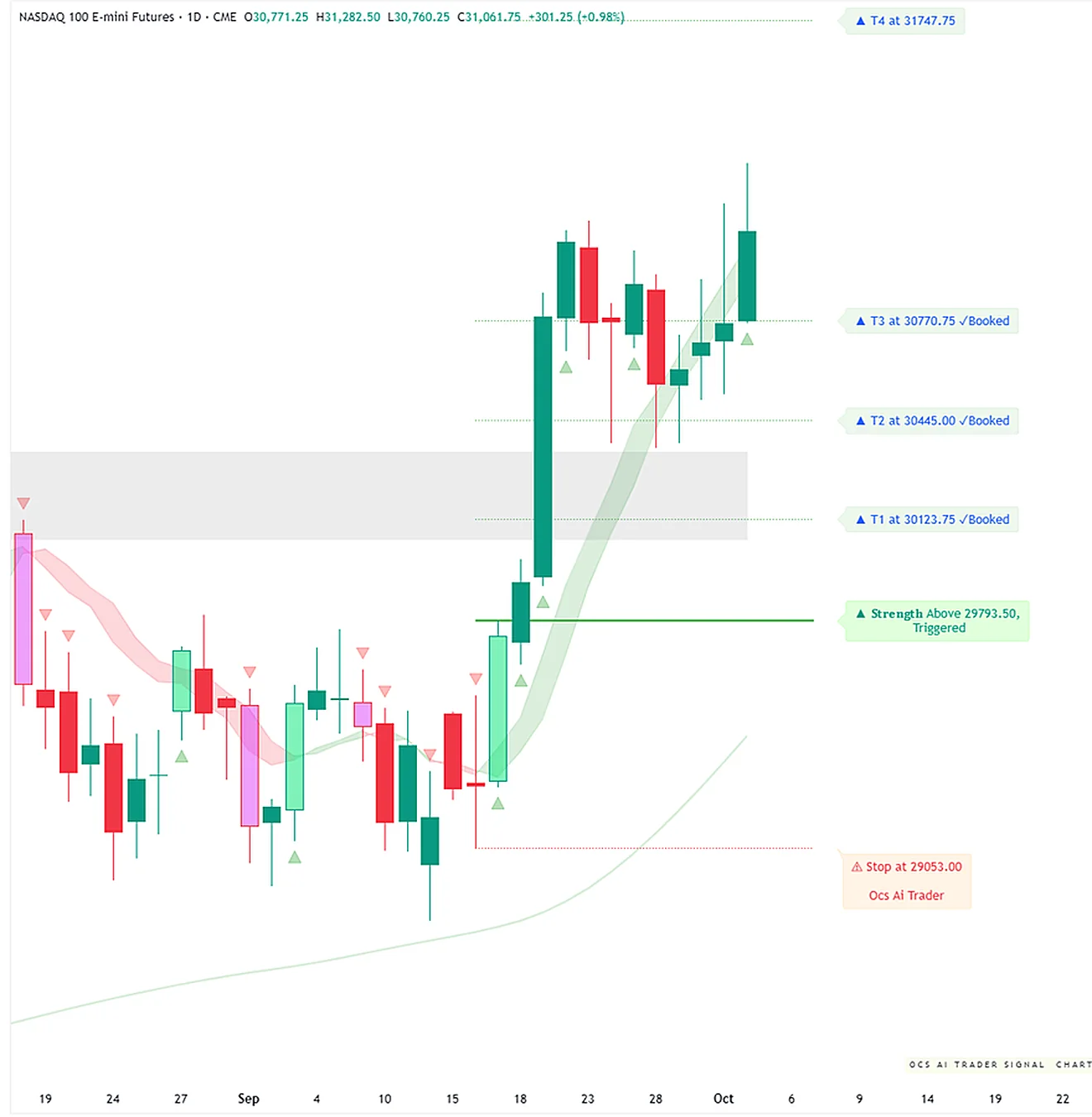
Education and market research only, not financial advice. Charts are OCS AI Trader readings at the time of writing and change with new bars.