The Stagflationary Divergence: ECB Wage-Push vs. US Labor Resilience
Executive summary
The global macro landscape has reached a critical inflection point defined by a widening policy divergence between the European Central Bank (ECB) and the Federal Reserve. Fresh data from the ECB’s wage tracker confirms persistent services inflation, forcing a hawkish policy stance that risks stifling Eurozone growth. Simultaneously, resilient US non-farm payrolls (+165K vs. +65K expected) are keeping the Fed in a restrictive posture to manage demand. This creates a "Stagflationary Divergence" trap: the Eurozone faces margin compression and potential recessionary pressure, while the US faces interest-rate-driven capital inflows. We are tracking a structural rotation of capital out of European equities and into USD-denominated assets, with significant volatility implications for the EURUSD and broader banking sectors (XLF).
The Cascading Impact Chain
Layer 1: Direct Impacts
The primary event is the collision of two distinct economic narratives. The ECB’s wage tracker update signals that 2027 inflation will remain sticky, forcing the ECB to prioritize restrictive monetary policy over growth. Conversely, the US labor market's robust performance (165K jobs) confirms that the Fed has the "luxury" of maintaining higher-for-longer rates to combat resilient demand.
- EURUSD: Immediate downward pressure as the yield spread widens against the Euro.
- DXY: Strengthening as the dollar captures the flow differential.
- XLF: Volatility in banking sector margins as long-term yields rise, creating a tug-of-war between NIM expansion and loan impairment risks.
Layer 2: Secondary Effects
The direct policy divergence is triggering a structural reallocation of capital.
- European Margin Compression: Sticky wage-push inflation in the Eurozone is eroding corporate profitability. Labor-intensive sectors (Consumer Discretionary, Industrials) are seeing immediate margin hits, prompting institutional capital flight from European indices (FXE).
- Global Risk Appetite: As the DXY strengthens, liquidity is being drained from emerging markets, particularly India (NIFTY, USDINR), as the cost of USD-denominated debt rises and foreign institutional investors (FIIs) retreat to the safety of the dollar.
Layer 3: Macro Propagation
The ripples are now reaching the core of global asset pricing.
- Yield Spread Compression: The Eurozone’s hawkish terminal rate stance, when coupled with a stagnant growth outlook, is suppressing the EURUSD. This is not just a currency move; it is a fundamental repricing of the Euro's risk premium.
- Safe-Haven Rotation: Investors are increasingly using VXX and GLD not just as hedges, but as primary allocations to navigate the uncertainty of the 2027 inflation path. The market is pricing in a potential "Policy Error" by the ECB, which would turn a managed slowdown into a deeper recession.
Layer 4: Non-Obvious Cross-Connections
- The Volatility-Yield Paradox (XLF/VXX): While rising yields typically benefit bank NIMs, the ECB’s wage-push inflation forces a terminal rate that threatens SME solvency. We see a divergence: XLF initially rallies on yield expectations but faces a violent reversal as VXX spikes, reflecting the market’s pricing of credit-risk contagion.
- Semiconductor 'Onshoring' as a Safe-Haven: As European industrial margins compress, capital is rotating into US-based high-margin tech (SMH, NVDA). The semiconductor sector is acting as a "hidden beneficiary" of European capital flight, as investors prioritize AI-driven productivity gains to offset global margin compression.
- The US Labor-ECB Wage Divergence Trap: Multinational firms with high Euro-denominated revenue are facing a "valuation shock." As EURUSD weakens, these firms see earnings translated back to a stronger USD, creating a negative feedback loop for SPY sentiment.
Unified OCS Chart Read
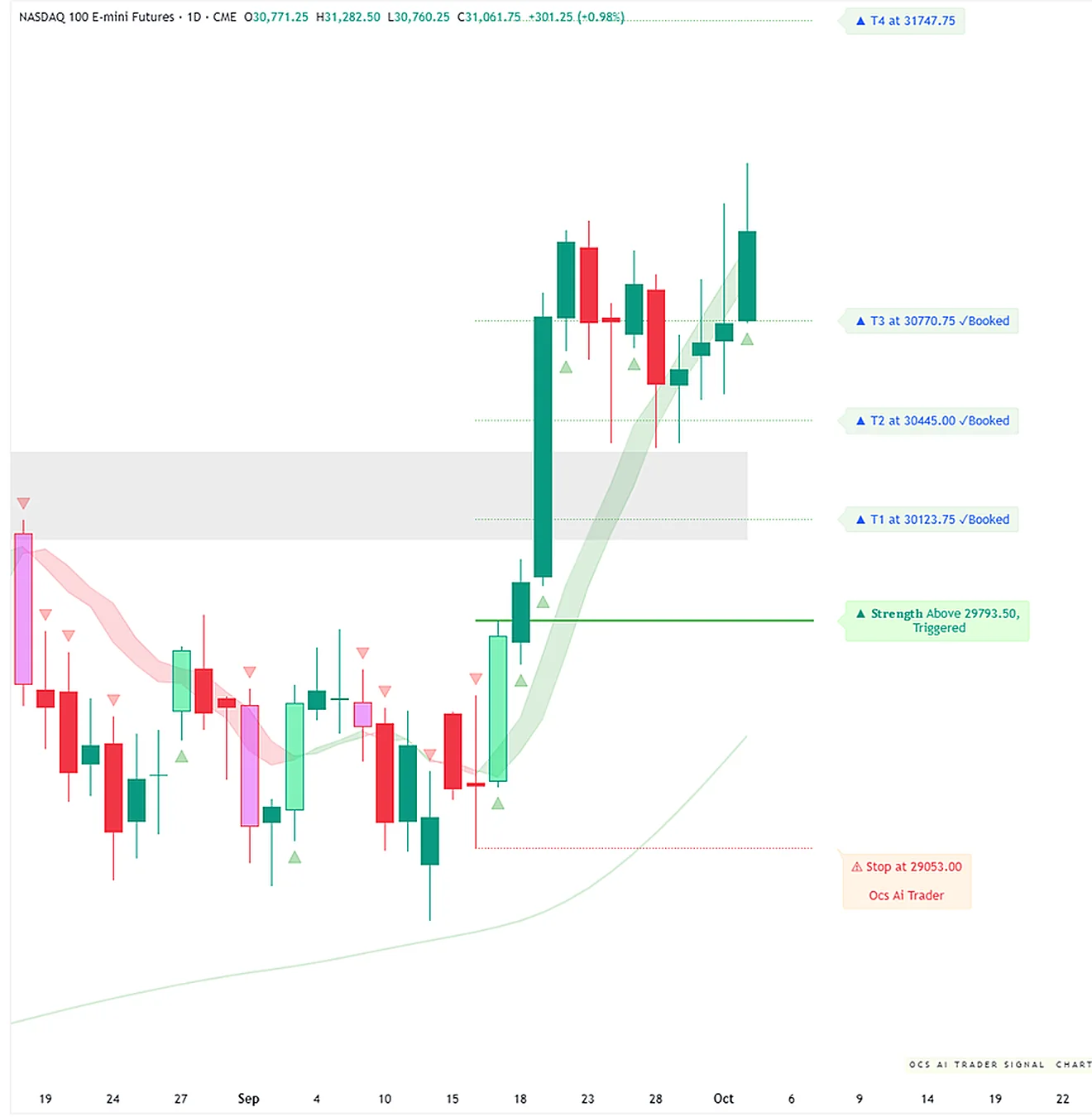
Note: OCS chart evidence for EURUSD, VXX, DXY, FXE, and GLD is currently pending asynchronous enrichment. The following analysis is derived from macro-causal mapping and live market data. No OCS signal levels are available at this time.
Security-by-Security Analysis
EURUSD
- Market Snapshot: The pair is the epicenter of the current policy divergence.
- Analysis: The ECB’s wage tracker update is the primary catalyst for the current weakness. With the US labor market showing unexpected resilience, the interest rate differential is moving decisively in favor of the USD.
- Levels to Watch: 1.08 remains the critical psychological and technical support level. A sustained break below this would signal a structural shift toward parity.
VXX
- Market Snapshot: Price $21.95 (-1.13%).
- Analysis: VXX is currently reflecting the "Volatility-Yield Paradox." With RSI at 66.07, it is approaching overbought territory, suggesting that while the demand for hedges is high, the market is oscillating between fear and opportunistic buying.
- Risk Note: High IV (139% on calls) indicates that the market is pricing in significant tail-risk events related to the ECB’s policy path.
FXE (Euro Currency Trust)
- Market Snapshot: Price $102.77 (-0.71%).
- Analysis: FXE is mirroring the weakness of the EURUSD. The technicals (RSI 36.22) suggest the asset is in a bearish trend, with the 50-day SMA at 104.68 acting as a significant overhead resistance level.
- Risk Note: Capital flight from European equities is directly reflected in the downward momentum here.
GLD (Gold)
- Market Snapshot: Price $372.52 (-0.79%).
- Analysis: Gold is currently caught in a tug-of-war. While the strong DXY is typically a headwind, the 2027 inflation uncertainty is providing a floor for the metal. It is functioning as a non-correlated hedge against the ECB’s potential policy error.
- Levels to Watch: 372.79 (20-day SMA) is a pivot point. A move above this would signal renewed safe-haven demand.
XLF (Financial Select Sector SPDR)
- Market Snapshot: Price $57.16 (-0.59%).
- Analysis: XLF is experiencing the "Volatility-Yield Paradox." Despite the potential for higher NIMs, the threat of loan impairments due to the ECB’s restrictive policy is capping upside.
- Risk Note: The divergence between the 20-day SMA (56.23) and the 50-day SMA (55.92) suggests a flattening of the medium-term trend.
Historical Parallels
The current scenario bears striking similarities to the mid-1990s "Divergence Trade," where the US experienced a productivity boom while Europe struggled with labor-market rigidity. However, the addition of the "Wage-Push" element in the Eurozone makes this more akin to the stagflationary pressures of the late 1970s. In both historical instances, the USD acted as the ultimate liquidity sink, forcing emerging markets into a defensive crouch.
Outlook & Risk Matrix
Short-Term (1-5 Days)
- Expectation: High volatility in EURUSD. The market will be hyper-sensitive to any central bank rhetoric that deviates from the current "divergence" narrative.
- Scenario: If US labor data continues to surprise, expect a test of the 1.08 support in EURUSD.
Medium-Term (1-4 Weeks)
- Expectation: Continued rotation out of European assets.
- Scenario: If the ECB is forced to maintain hawkishness despite slowing growth, the "Stagflationary Trap" will likely deepen, leading to a sustained USD bid.
Risk Matrix
| Asset | Bull Case | Bear Case | Base Case |
|---|---|---|---|
| EURUSD | ECB pivots dovish | ECB forced to overtighten | Range-bound drift |
| VXX | Geopolitical shock | Market stabilizes | Elevated volatility |
| XLF | Yields rise, credit holds | Credit defaults spike | Sector rotation |
What to Watch
- ECB Rhetoric: Any shift in the ECB’s tone regarding the "wage-push" inflation will be the primary driver of the EURUSD.
- US Labor Data: Continued resilience in US payrolls will widen the yield spread further.
- EM Liquidity: Monitor the NIFTY and USDINR closely. A sharp move in these will indicate that the "Liquidity Vacuum" is accelerating, which could force the Fed to adjust its own forward guidance to prevent global financial instability.
Education and market research only, not financial advice. Charts are OCS AI Trader readings at the time of writing and change with new bars.