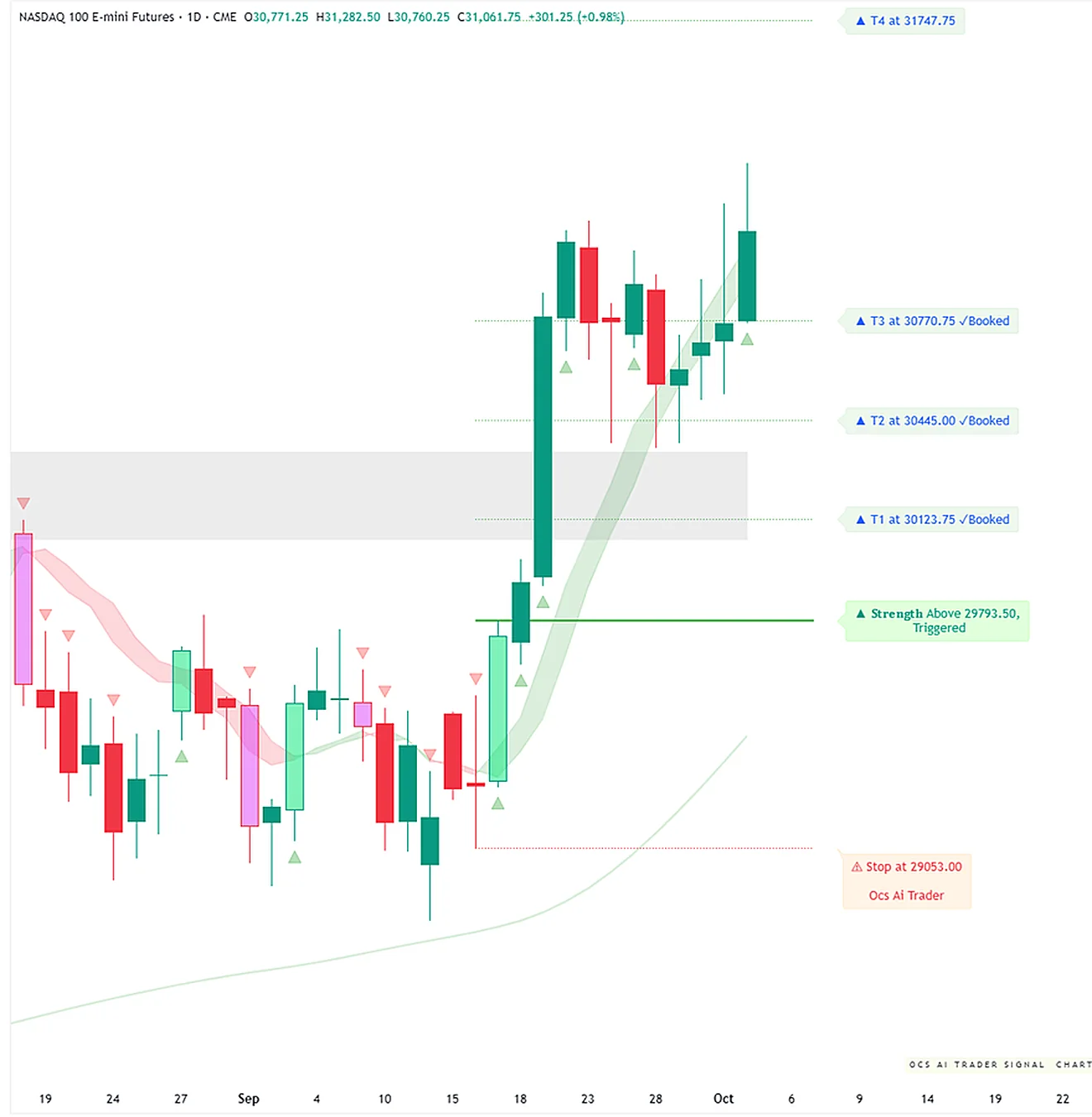
The Beijing Pivot and the Warsh Wall: A Multi-Layer Analysis of the Nasdaq’s New AI-Yield Pincer
Thursday, May 14, 2026
The global macro landscape has shifted violently in the last 24 hours, caught between a tactical "thaw" in the US-China tech war and a structural hardening of US monetary policy. As Presidents Trump and Xi conclude their high-stakes summit in Beijing, the immediate market reaction has been a surge in semiconductor euphoria—led by the surprise approval of Nvidia’s H200 silicon for the Chinese market. However, beneath the surface of the Nasdaq’s record-breaking run, a more ominous "Warsh Era" is beginning at the Federal Reserve, threatening to collide with a massive supply-side squeeze in memory and networking infrastructure.
Today’s report traces the cascading impact of these events: from the direct revenue boost for Nvidia to the non-obvious margin compression facing US hyperscalers as they enter a "defensive capex" race against a newly re-armed Chinese tech sector.
Executive Summary: The Story of the "Double Pincer"
The market is currently processing two contradictory forces. On one side, the Beijing Pivot—characterized by the approval of H200 sales to ten Chinese firms and the suspension of antitrust probes by China’s SAMR—is a massive "risk-on" catalyst for the semiconductor sector (NVDA, MRVL, AVGO). On the other side, the Warsh Wall—the confirmation of Kevin Warsh as Fed Chair amid 3.8% US inflation—is driving yields higher and strengthening the Dollar (UUP), creating a valuation headwind for the very same growth names.
The "Alpha" in today’s session is not found in the raw compute of Nvidia, but in the Networking Bottleneck. As China deploys H200 clusters, the demand for Marvell’s optical interconnects and Broadcom’s switching fabric is exploding, explaining MRVL's +8.18% outperformance relative to NVDA's +2.29%.
Layer 1: Direct Impacts — The Beijing Thaw and the Fed Transition
The most immediate catalyst is the H200 Approval. By allowing Nvidia to sell its high-end AI silicon to restricted Chinese entities, the US has effectively expanded the Total Addressable Market (TAM) for the XLK (Technology Select Sector SPDR Fund) by billions overnight.
- NVDA (Nvidia): Shares rose 2.29% to $225.83. The direct revenue boost from the Chinese market is tangible, but the stock is hitting overbought territory (RSI at 72.14).
- XLK (Tech ETF): Gained 0.94% to $176.85. The ETF is riding the wave of semiconductor optimism, though it is currently hugging its upper Bollinger Band ($179.20), suggesting limited near-term upside without a consolidation.
- The Warsh Confirmation: The US Senate’s confirmation of Kevin Warsh as Fed Chair has immediately shifted the yield curve. With April inflation jumping to 3.8%, the "Warsh Era" is expected to be defined by aggressive Quantitative Tightening (QT) and higher-for-longer rates. This has bolstered the UUP (USD Index) and put downward pressure on TLT (20+ Year Treasury Bond ETF) as markets price in a more hawkish Fed.
Layer 2: Secondary Effects — The Networking Squeeze and HBM Scarcity
As the "Beijing Thaw" allows for the deployment of massive AI clusters in China, the focus is shifting from the chips themselves to the infrastructure required to connect them.
- Networking Dominance (MRVL, AVGO): You cannot run an H200 cluster at scale without high-speed networking. Marvell (MRVL) saw a violent +8.18% move to $177.95 today. This is a classic secondary effect: Nvidia provides the "brain," but Marvell provides the "nervous system" (optical interconnects).
- Memory Scarcity (MU): Micron’s announcement that its 2026 High Bandwidth Memory (HBM) capacity is already sold out—with 50% price hikes projected for 2027—is a critical secondary shock. This creates a massive input cost for NVDA and AMD, but a direct windfall for MU.
- Regulatory Goodwill: China’s SAMR (State Administration for Market Regulation) has suspended several antitrust investigations into US tech firms. This lowers the M&A risk premium for names like INTC and QCOM, who have long been stymied by Chinese regulatory hurdles.
Layer 3: Macro Propagation — The Yield-Margin Feedback Loop
The macro ripple effects are now moving into the currency and credit markets.
- The USD-Semi Correlation Break: Normally, a surging Dollar (UUP) is a headwind for US semiconductors with high China exposure (like QCOM and MRVL). However, we are seeing a rare correlation break. The compression of the "Geopolitical Risk Premium" due to the Trump-Xi summit is outweighing the currency headwind. Investors are willing to overlook a strong USD if the threat of a total tech decoupling has been pushed into the future.
- Hyperscaler Debt Pressure: US Hyperscalers (MSFT, AMZN, GOOGL) are now forced into "Defensive Capex." To maintain their lead over Chinese giants like Alibaba and Tencent—who now have access to H200s—they must accelerate their own infrastructure spending. This requires massive capital, likely funded by corporate bond issuance. In a "Warsh Fed" environment of rising yields, this increases interest expense and compresses net margins for the "Magnificent Seven."
Layer 4: Non-Obvious Connections — The Alpha Insights
This is where the analysis moves beyond the headlines.
1. The "Networking Bottleneck" Timing Cascade
There is a 1-3 month lag between the delivery of AI chips and the realization that networking fabric is the primary constraint. We are currently in the "Second Wave" of the AI trade. While the market cheered NVDA last year, the smart money is moving into AVGO and MRVL because raw compute (H200) is useless if it cannot communicate across the cluster. MRVL’s 36% revenue exposure to China makes it the purest play on this "Beijing Pivot."
2. The Analog Scarcity Paradox
As the world obsesses over 3nm AI chips, the production of these chips and the front-running of equipment (ASML, AMAT) is diverting foundry capacity away from legacy "analog" nodes. This is creating an artificial supply shock for industrial and automotive chips. Texas Instruments (TXN) and Analog Devices (ADI) may soon gain unexpected pricing power, not because demand is surging, but because the AI build-out has "crowded out" their production capacity.
3. The "Defensive Capex" Margin Squeeze
The most dangerous non-obvious connection is the feedback loop between MU and MSFT. Micron is raising HBM prices by 50%. Simultaneously, the Beijing Pivot forces Microsoft and Google to spend more to stay ahead of China. They are being squeezed from both sides: they must buy more hardware, and that hardware is becoming exponentially more expensive due to memory costs. Expect a "surprise" margin miss from the Hyperscalers in late 2026.
Security-by-Security Analysis
NVDA (Nvidia)
- Price: $225.83 (+2.29%)
- Technicals: RSI(14) at 72.14 indicates overbought conditions. MACD is bullish (7.82), but the stock is trading above its Upper Bollinger Band ($224.49).
- Options Flow: Massive volume in the $210 and $212.50 Puts (over 22,000 contracts) suggests traders are hedging for a "sell the news" reaction following the summit conclusion.
- Causal Chain: H200 Approval → China Revenue Surge → Overbought Technicals → Potential Mean Reversion.
MRVL (Marvell Technology)
- Price: $177.95 (+8.18%)
- Technicals: A violent breakout. SMA 50d is at $124.08, meaning the stock is extended, but the MACD histogram shows momentum is still accelerating.
- Causal Chain: Beijing Pivot → H200 Cluster Deployment → Optical Interconnect Demand → Revenue Re-rating.
- Note: Marvell is the "Alpha" trade of the day due to its high China exposure (36%).
MU (Micron Technology)
- Price: [Data indicates HBM sell-out]
- Causal Chain: AI Build-out → HBM3e Capacity Exhaustion → 50% Price Hikes → Margin Expansion at the expense of NVDA/MSFT.
- Note: MU is the "Toll Collector" of the AI era.
META (Meta Platforms)
- Price: $616.63 (+2.26%)
- Technicals: RSI is neutral (46.55). Unlike NVDA, META has room to run before hitting overbought levels.
- Options Flow: Unusual activity in the $580 and $582.50 Puts (high OI) suggests a floor is being established by institutional put-sellers.
- Causal Chain: Risk-on Sentiment → Ad-spend recovery expectations → Valuation catch-up.
UUP (Invesco DB US Dollar Index)
- Price: Strengthening
- Causal Chain: Warsh Fed Confirmation + 3.8% Inflation → Yield Curve Steepening → Capital Flight to USD.
Historical Parallels: 1994 and 2018
Today’s environment mirrors 1994, when the Fed (under Greenspan) doubled interest rates in a single year to "pre-empt" inflation. Like today, the market initially struggled but eventually rallied as productivity gains (then the PC, now AI) offset the cost of capital.
It also echoes the 2018 Trade War "Pauses." Whenever the US and China signaled a tactical truce, semiconductors rallied 10-15% in a matter of days, only to retreat when structural issues (IP theft, Taiwan) resurfaced. Investors should treat the "Beijing Pivot" as a tactical window, not a permanent peace.
Outlook & Risk Matrix
| Horizon | Sentiment | Key Levels | Driver |
|---|---|---|---|
| Short-Term (1-5 Days) | Bullish/Volatile | NVDA $230, XLK $180 | Post-summit momentum and H200 order front-running. |
| Medium-Term (1-4 Weeks) | Cautious | TLT $90, MRVL $160 | The "Warsh Shock" as the Fed begins aggressive QT. |
Scenarios:
- Bull Case: H200 orders from China exceed $10B in Q3; Warsh signals a "measured" approach to QT. Nasdaq targets new ATHs.
- Bear Case: Inflation hits 4.0%; Warsh initiates a 50bps "shock" hike; China resumes military drills near Taiwan. Violent rotation out of Tech into Energy/Defensives.
- Base Case: Tech remains bid on AI fundamentals, but rising yields cap the multiple. Market becomes a "stock-picker's" environment focusing on networking (AVGO, MRVL) over raw compute.
What to Watch
- The 10-Year Yield: If it crosses 4.8% (the "Warsh Threshold"), the Nasdaq will likely de-rate regardless of AI news.
- HBM Pricing Tiers: Watch for any pushback from MSFT or AMZN regarding MU's 50% price hikes. A "Capex Strike" by hyperscalers is the biggest tail risk for the AI trade.
- SAMR Official Statements: If China officially clears the INTC/Tower or similar stalled deals, it confirms the "Beijing Pivot" is structural, not just a summit photo-op.
Final Thought: We are witnessing the birth of the "Warsh-H200" era—a period where AI-driven growth is real, but the cost of funding that growth is about to become significantly more expensive. Long networking, watch the yields.
Education and market research only, not financial advice. Charts are OCS AI Trader readings at the time of writing and change with new bars.