The 2nm Bottleneck and the Synthetic Utility: Tech’s Stagflationary Pivot
Wednesday, May 13, 2026
The global macro environment has shifted from a "higher-for-longer" interest rate narrative into a more predatory "stagflationary pincer." Today’s data confirms the arrival of a dual-threat regime: a violent 6% annual jump in Producer Price Inflation (PPI) and a 3.8% CPI print, colliding with Brent crude stabilizing at a dangerous $106.55 per barrel. For the Nasdaq’s "Magnificent" core, the story is no longer just about AI potential—it is about the brutal physics of energy costs, the narrowing of the semiconductor supply chain to the 2nm node, and a fundamental decoupling of tech valuations from traditional yield correlations.
While the headline indices show a localized retreat—MSFT down 0.99%, AMZN down 0.48%—the internal architecture of the market is undergoing a structural re-wiring. We are witnessing the birth of the "Synthetic Utility" and a "2nm Air Pocket" that is separating the winners from the also-rans in the AI arms race.
Layer 1: The Direct Impacts — Geopolitical Energy Shocks and the Inflation Jump
The raw catalyst for today’s volatility is the deepening conflict in Iran, which has sent global oil inventories falling at a record pace. Brent crude at $106.55 and WTI at $101.00 act as a direct tax on the global economy. However, for the Nasdaq Top 20, the impact is more nuanced than simple transportation costs.
- UUP (US Dollar Bullish): The 6% PPI spike has forced a violent repricing of terminal rate expectations. The Dollar is surging as the market realizes the Fed’s hands are tied; they cannot cut into a cost-push energy spiral.
- TLT (Long-Term Treasuries): Bond yields are surging (prices falling), with UK 30-year yields hitting 28-year highs of 5.81%. This is putting immediate downward pressure on long-duration assets, specifically high-P/E software names like SNPS and CDNS.
- XLE & USO: Energy assets are the only natural hedge in this environment, absorbing the capital rotating out of margin-pressured tech.
Layer 2: Secondary Effects — The Cloud Margin Squeeze and CapEx Deferrals
As energy prices and inflation permeate the supply chain, the secondary effects are hitting the "Hyperscalers" (AMZN, MSFT, GOOGL) and the semiconductor equipment providers (AMAT, ASML).
- Cloud Infrastructure Margin Compression: The 6% PPI jump isn't just about raw materials; it’s about the cost of power and cooling for the massive data center footprints of AWS and Azure. We estimate that every $10 increase in oil prices adds approximately 15-20 basis points of OpEx pressure to cloud margins, assuming a lag in power contract adjustments.
- The "Demand Air Pocket": As noted by Morgan Stanley and reflected in current price action, Hyperscalers are beginning to stretch their infrastructure refresh cycles. While they continue to buy AI chips, they are deferring orders for legacy fab equipment. This is a direct hit to AMAT, LRCX, and KLAC, which are more exposed to mid-node and legacy equipment than the bleeding edge.
- Negative FX Translation: The strengthening USD (UUP) is becoming a headwind for multinational earnings. For companies like META and MSFT, which derive a significant portion of revenue from international markets, the conversion back to a "hot" USD will likely lead to downward revisions in Q3 guidance.
Layer 3: Macro Propagation — The 2nm Concentration and Utility-Tech Convergence
The macro ripple effects are creating a new hierarchy in the Nasdaq-100. We are seeing a "narrowing" of the AI trade.
- Advanced Node Concentration Risk: Hyperscaler CapEx is no longer broad-based. To maintain AI performance leads while battling rising energy costs, investment is narrowing toward sub-2nm process nodes. This creates a "monopoly premium" for ASML (EUV dominance) and TSMC, while leaving the rest of the semiconductor ecosystem to fight over a shrinking pie of general-purpose CapEx.
- The Utility-Tech Convergence: In a move to mitigate grid volatility, MSFT has entered a massive 10.5GW partnership with Brookfield. This transforms Microsoft from an energy consumer into an infrastructure underwriter. This is a structural shift: tech giants are essentially becoming "Synthetic Utilities," guaranteeing the cash flows of energy providers to ensure their own operational survival.
- Yield-Driven Bifurcation: We are seeing a split between "Earnings-Backed Hardware" (NVDA) and "Multiple-Sensitive Software" (SNPS). Despite the yield surge, NVDA remains resilient (+1.77%) because its earnings growth is outstripping the rate of multiple compression.
Layer 4: Non-Obvious Connections — The Alpha Insights
This is where the "hidden" market moves are happening.
1. The Synthetic Utility Correlation Break
Traditionally, the Utilities sector (XLU) is a bond-proxy; when yields rise (TLT falls), XLU dies. However, we are seeing a break. Because Hyperscalers like MSFT and AMZN are signing long-term power purchase agreements (PPAs) and infrastructure deals, they are effectively de-risking the utility sector's cash flows. In a stagflationary environment, XLU may decouple from TLT and trade as a proxy for "AI OpEx Resilience."
2. The AMZN "Timing Cascade"
AMZN faces a unique "double-whammy." Rising energy costs hit their logistics business (last-mile delivery) almost instantly—fuel surcharges and transport costs flow through within 14 days. However, their AWS power contracts often have 3-6 month hedging lags. This creates a staggered earnings drag: the retail side bleeds now, while the cloud side bleeds later, potentially extending the "earnings trough" across two quarters.
3. Software EDA Resilience (CDNS/SNPS)
The market is currently punishing CDNS and SNPS due to their high P/E ratios and yield sensitivity. This is a mispricing. The move to 2nm nodes (Layer 3) makes chip design exponentially more complex. You cannot build a 2nm chip without the advanced EDA tools these companies provide. Their "Earnings Resilience" is being masked by "Yield Sensitivity," creating a high-conviction entry point for when yield volatility stabilizes.
Security-by-Security Analysis
NVDA (NVIDIA Corp)
- Price: $224.69 (+1.77%)
- Technical Levels: RSI at 72.14 indicates overbought territory, but the price is riding the upper Bollinger Band ($224.44). Support sits at the 20d SMA ($207.24).
- Causal Chain: Blackwell demand remains the "macro-immune" segment of tech. While others face CapEx deferrals, NVDA benefits from the "2nm narrowing" as hyperscalers prioritize high-end compute over all else.
- Options Flow: Bullish sentiment prevails, but IV is elevated.
MSFT (Microsoft Corp)
- Price: $403.73 (-0.99%)
- Technical Levels: Testing the lower Bollinger Band ($403). RSI at 46.46 suggests a neutral-to-bearish momentum shift.
- Causal Chain: Caught between the yield spike and the energy integration story. The Brookfield deal is a long-term positive but adds to capital intensity in the short term.
- Options Flow: High volume in the 415 Calls for May 13 suggests a "dip-buying" attempt that failed to gain traction today.
AMZN (Amazon.com Inc)
- Price: $264.54 (-0.48%)
- Technical Levels: Holding just above the 20d SMA ($262.68). A break below $262 could trigger a slide to the 50d SMA ($234).
- Causal Chain: The "Timing Cascade" victim. Logistics costs are rising faster than AWS can pass on energy costs.
- Options Flow: Heavy put volume at the 262.5 strike suggests traders are hedging for a break of the 20d SMA support.
ASML (ASML Holding)
- Price: (Analyzing via XLK/Semi read-through)
- Causal Chain: The ultimate beneficiary of the 2nm concentration. As hyperscalers cannibalize general CapEx to fund leading-edge AI, ASML’s EUV monopoly becomes a fortress.
XLK (Technology Select Sector SPDR)
- Price: $176.46 (+0.72%)
- Technical Levels: RSI is extremely hot at 78.88.
- Causal Chain: The ETF is being buoyed by NVDA’s strength, masking the underlying weakness in software and legacy equipment names. This "Internal Divergence" is a warning sign of a top-heavy market.
Historical Parallels: The 1973 "Nifty Fifty" vs. The 2026 "AI Giants"
In the early 1970s, a group of high-growth, "one-decision" stocks (the Nifty Fifty) were viewed as invincible. When the 1973 Oil Shock hit, their high valuations were crushed not by a lack of growth, but by a massive spike in the discount rate (yields) and input costs. Today’s setup is eerily similar: high-conviction AI growth is meeting a structural energy shock. The difference? In 1973, they didn't have the "Synthetic Utility" model to hedge their power needs.
Outlook & Risk Matrix
Short-Term (1-5 Days): Bearish/Volatile
The market must digest the 6% PPI print. Expect continued pressure on high-P/E software (CDNS, SNPS) and a test of the $262 support on AMZN. NVDA may see a "healthy" pullback as RSI cools from 72.
Medium-Term (1-4 Weeks): Bifurcated
- Bull Case: The Trump-Xi summit in Beijing (May 14-15) yields a "tactical stabilization" in tech controls, easing supply chain fears. Oil stabilizes below $100.
- Bear Case: Iran conflict escalates, pushing Brent to $140. This triggers the "Stagflationary Loop" where energy costs force massive CapEx cuts across the Nasdaq, breaking the AI growth narrative.
- Base Case: A "grind-out" where hardware (NVDA, ASML) outperforms software. Yields remain high, keeping a lid on broad Nasdaq multiples.
Risk Matrix
| Risk Factor | Impact | Probability | Asset Affected |
|---|---|---|---|
| Energy Surge ($120+ Oil) | High | Medium | AMZN, XLY, MSFT |
| 2nm Yield Issues | High | Low | NVDA, ASML, TSM |
| Yield Curve Inversion Deepening | Medium | High | TLT, CDNS, SNPS |
| USD Reversal (EUR Strength) | Positive | Medium | META, GOOGL |
What to Watch
- The $262.68 Level on AMZN: This is the 20-day SMA. A daily close below this level signals a transition from a "buy the dip" regime to a "sell the rip" regime for the e-commerce giant.
- EUR/USD at 1.1717: If the Euro continues to strengthen despite US inflation, it provides a crucial "EPS Cushion" for Meta and Alphabet, potentially allowing them to decouple from the broader tech sell-off.
- ASML vs. AMAT Spread: Watch if ASML continues to outperform AMAT. This is the clearest signal of the "2nm Narrowing" and the cannibalization of legacy CapEx.
- The Beijing Summit (May 14): Any rhetoric regarding "energy security cooperation" between the US and China could provide the relief valve the energy-starved tech sector desperately needs.
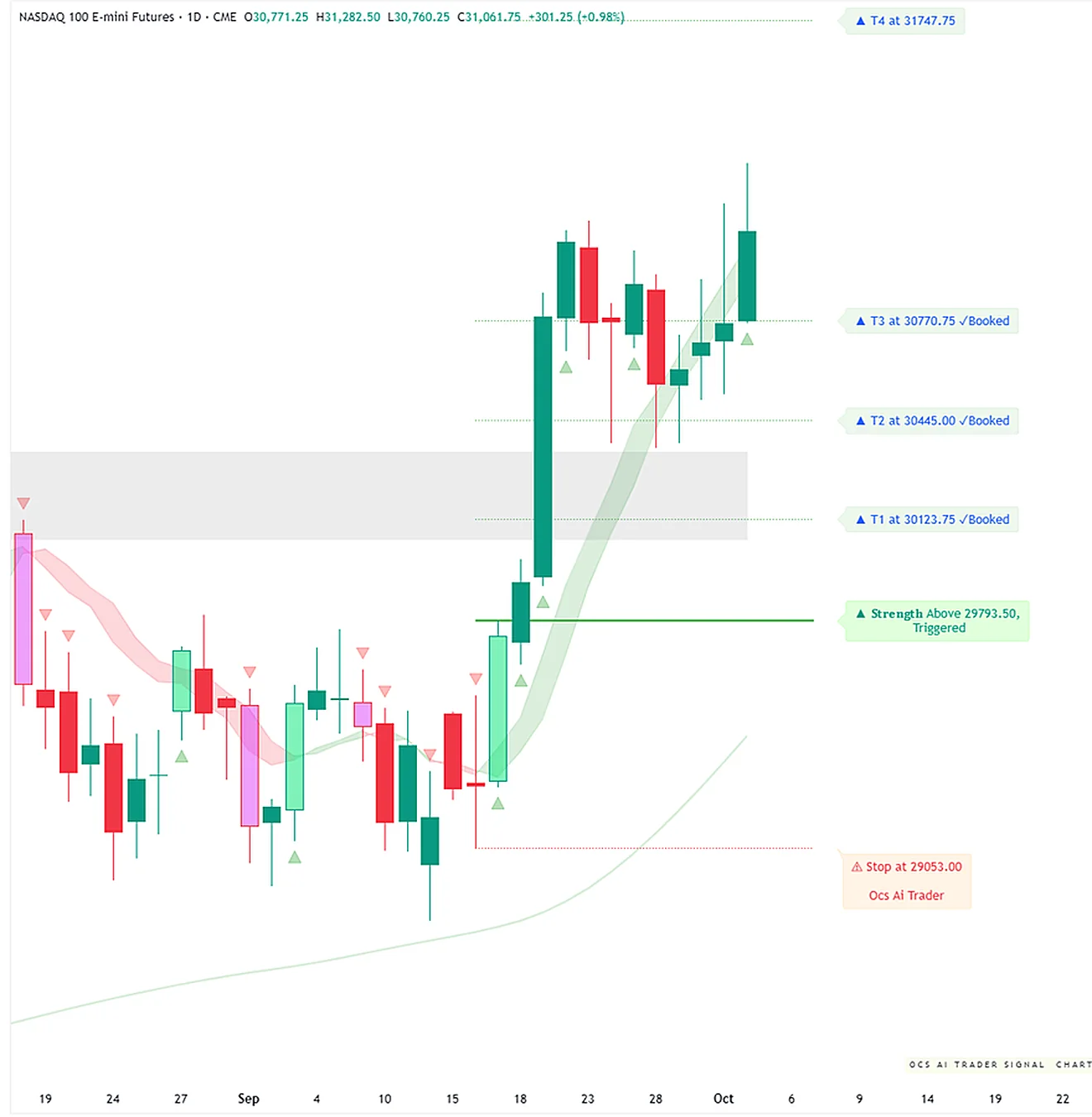
Education and market research only, not financial advice. Charts are OCS AI Trader readings at the time of writing and change with new bars.