The Liquidity Vacuum: Tech Governance Shocks Meet ECB Hawkishness
Executive summary
Global markets are currently navigating a dual-shock regime characterized by a sudden breakdown in high-beta tech leadership and a fundamental shift in transatlantic monetary policy divergence. The unexpected leadership controversy at Nvidia (NVDA) has triggered a localized liquidity drain within the Nasdaq (NQ) complex, exposing the fragility of AI-infrastructure valuations. Simultaneously, hotter-than-expected wage growth data from the Eurozone has forced a hawkish repricing of European Central Bank (ECB) interest rate expectations. This convergence—a "liquidity vacuum"—is driving a rapid rotation out of US-denominated growth assets and into European yield-sensitive vehicles, while simultaneously destabilizing emerging market carry trades. We are witnessing a structural re-rating of risk: the "AI-beta" trade is being sacrificed to cover liquidity gaps, while the "ECB-hawkish" trade is forcing a re-evaluation of the EURUSD yield differential.
Layer 1: Direct Impacts — The Spark
The market is currently reacting to two distinct, high-impact events:
- Nvidia Leadership Controversy: The reported governance crisis at Nvidia (NVDA) has transitioned from a corporate news item to a systemic risk factor. The potential for a leadership vacuum at the center of the AI-supercycle has triggered an immediate, aggressive liquidation of NVDA shares. Given NVDA’s outsized weighting in the Nasdaq-100 (NQ) and the semiconductor sector (SMH/XLK), this has forced systematic margin calls and a broad-based sell-off in growth-oriented tech indices.
- ECB Wage-Tracker Hawkishness: Data releases regarding Eurozone wage growth have surprised to the upside, forcing a hawkish repricing of the ECB’s terminal rate expectations. This shift directly challenges the prevailing narrative of global central bank synchrony. Markets are now adjusting for a more restrictive ECB stance, which has immediate implications for the EURUSD pair and European financial sector margins.
Layer 2: Secondary Effects — Sector Rotation and Margin Shifts
The direct impacts are cascading into clear sector-level rotations:
- Eurozone Banking Expansion: The hawkish ECB outlook is a net positive for European commercial banking margins. As terminal rate expectations rise, the net interest margin (NIM) expansion potential for European lenders increases, providing a fundamental support for the Euro against the USD, independent of global risk sentiment.
- US Tech-Heavy Liquidity Drain: The NVDA-led sell-off is not occurring in isolation. It is triggering a "liquidity vacuum" where investors are forced to trim high-beta positions (NQ) to meet margin requirements. This is creating a negative feedback loop: as tech valuations compress, the collateral value of these holdings falls, necessitating further liquidations.
- Industrial Divergence: We are observing a split in industrial sector performance. European industrials (XLI-proxies) face input cost pressure due to sticky wage inflation and a strengthening Euro. Conversely, US-based industrial exporters are finding a "hidden" tailwind; the weakening of the DXY—driven by EURUSD strength—is improving their global price competitiveness.
Layer 3: Macro Propagation — Yield Spreads and Carry Trades
The macro-environment is shifting from a "US-exceptionalism" narrative to one of policy divergence:
- Yield Spread Widening: The primary macro propagation mechanism is the widening of the EUR-USD yield spread. As the ECB maintains a hawkish bias while the Fed pivots, the interest rate differential is narrowing. This is driving aggressive capital repatriation to the Eurozone, which is the fundamental driver of the current EURUSD appreciation.
- Carry Trade Deleveraging: The shift in ECB policy is the catalyst for a broader unwinding of USD-funded carry trades. Investors who were short EUR or long EM assets (like the Indian Rupee, USDINR) using cheap USD funding are now facing a "double-whammy": the cost of funding is rising relative to the ECB’s hawkish stance, and the liquidity drain from NQ is forcing them to cover positions. This is leading to forced selling in emerging markets (NIFTY/BANKNIFTY) as FIIs repatriate capital to cover global liquidity gaps.
- Stagflationary Gold Conflict: Gold (GLD) is caught in a structural trap. While safe-haven demand should theoretically increase amid policy uncertainty, the systematic liquidation of assets to cover NQ margin calls is creating a "dash for cash" that is temporarily suppressing precious metals.
Layer 4: Non-Obvious Connections & Hidden Risks
The most significant risks are found in the correlation breaks and timing cascades:
- The Liquidity Vacuum Timing Cascade: There is a distinct latency in the market's reaction. Immediate NQ selling triggers margin calls within the US session. However, the liquidation of Indian banking stocks (BANKNIFTY) and other EM assets typically follows with a 1-week delay as FIIs move to cover global liquidity gaps. This creates a "delayed but violent" correction profile for EM indices.
- Correlation Break (NIFTY vs. NIFTYIT): We are seeing a decoupling. While the broader NIFTY index is reacting to FII outflows (liquidity), NIFTYIT is facing a compounded negative shock: the NVDA-led sentiment decline plus the loss of the USDINR carry-trade hedge. This makes the IT sector significantly more vulnerable than the broader Indian market.
- The Stagflationary Trap: The market is underpricing a feedback loop where safe-haven flows into gold (XAU) signal a lack of confidence in central bank policy. This lack of confidence forces the ECB to maintain higher rates for longer to anchor expectations, which further strengthens the EURUSD, creating a self-reinforcing cycle of tightening financial conditions that eventually drags down even defensive assets.
Unified OCS Chart Read
Note: OCS chart evidence is currently unavailable for the planned tickers (EURUSD, NQ, GLD). Consequently, the following analysis is derived from fundamental causal mapping and price history data rather than OCS signal engine delta.
- EURUSD: Without current chart-level delta, the setup remains "Policy-Driven." The fundamental bias is bullish due to yield spread narrowing, but we lack OCS confirmation of institutional accumulation.
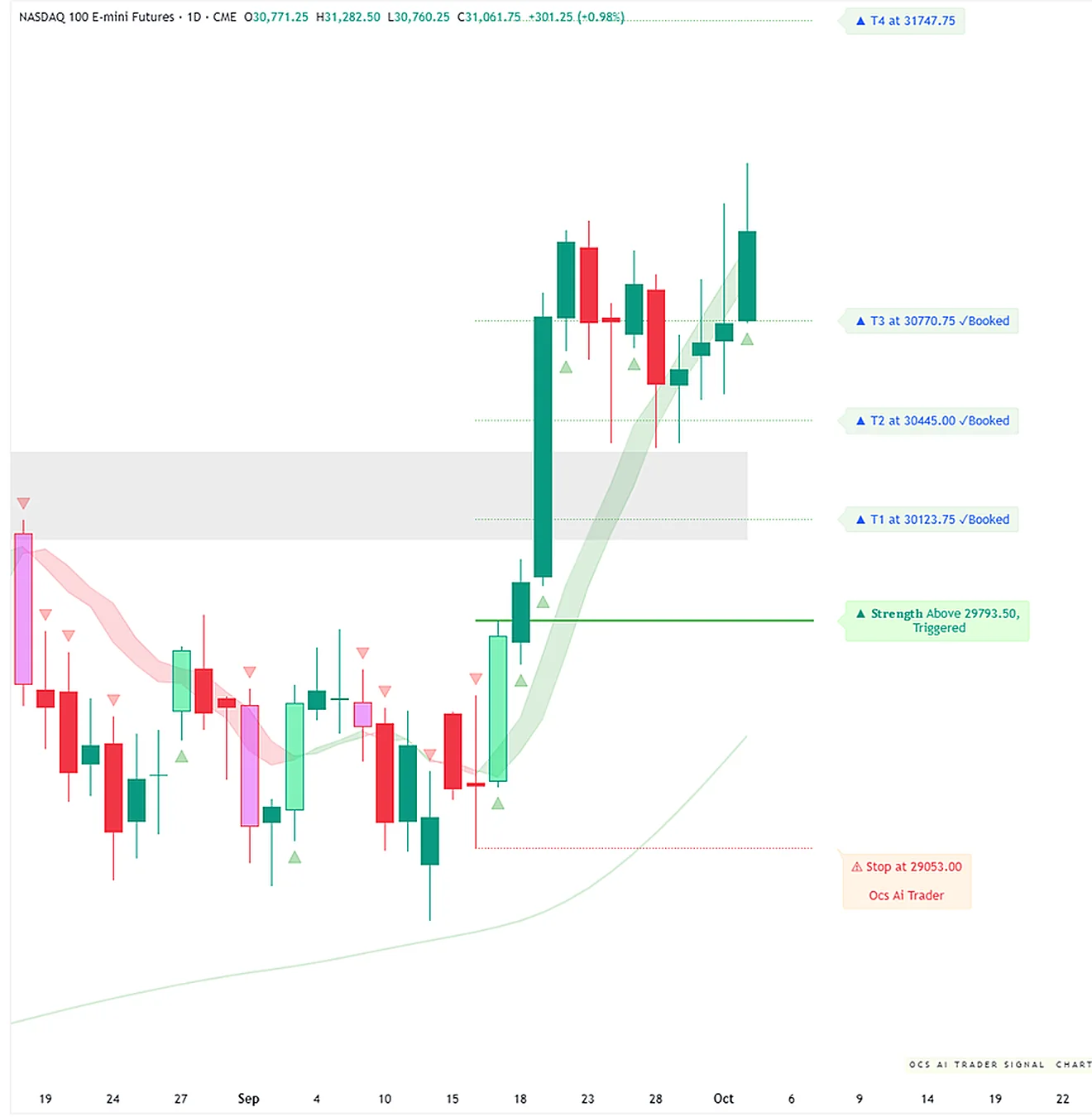
- NQ: The setup is "Liquidity-Negative." The price action is dominated by margin-call-driven selling. Until OCS signals show a exhaustion of selling volume, this remains a hands-off environment for long-side participants.
- GLD: The setup is "Liquidity-Trap." The contradiction between safe-haven fundamental demand and systematic liquidation (L3) makes this a high-volatility, low-visibility zone.
Security-by-Security Analysis
EURUSD
- Analysis: The pair is the primary beneficiary of the ECB’s hawkish wage-data surprise. The narrowing of the EUR-USD yield spread is the fundamental driver.
- Market Snapshot: Price action is currently trending higher as the market reprices the ECB terminal rate.
- Levels to Watch: 1.08 remains the critical psychological and technical pivot. A sustained break above this level would signal a shift in the medium-term trend.
- Risk Notes: The primary risk is an over-tightening by the ECB, which could trigger a recessionary shock, eventually causing a "dash for cash" back into the USD.
NQ (Nasdaq-100)
- Analysis: The index is suffering from the "NVDA contagion." The governance risk at Nvidia is acting as a catalyst for a broader re-rating of AI-infrastructure valuations.
- Market Snapshot: High volatility, with significant downside pressure as liquidity is drained to cover margin calls.
- Levels to Watch: Watch for support levels to hold; a breach of recent lows would confirm the "liquidity vacuum" thesis.
- Risk Notes: The "Liquidity Vacuum" timing cascade suggests that NQ weakness may persist as long as margin calls continue to ripple through the broader financial system.
GLD (Gold)
- Analysis: GLD is trapped between two forces: safe-haven demand (inflationary hedge) and liquidity liquidation (systematic selling).
- Market Snapshot: Price is under pressure ($365.17) as systematic sellers liquidate non-yielding assets to cover margin calls in the tech sector.
- Levels to Watch: $360 is a key support level. A breakdown here would suggest the "dash for cash" is overriding the inflation-hedge thesis.
- Risk Notes: The "Stagflationary Trap" feedback loop suggests that gold may remain volatile until the liquidity drain stabilizes.
XLI (Industrial Select Sector SPDR)
- Analysis: A hidden beneficiary. While European industrials suffer from wage inflation, US industrials are benefiting from the DXY weakness caused by the EURUSD rally.
- Market Snapshot: Trading at $170.97 (+1.33%). The sector is showing relative strength compared to the broader tech-heavy indices.
- Levels to Watch: $172.3 (Upper Bollinger Band) is the immediate resistance.
- Risk Notes: The outperformance is contingent on the DXY remaining weak. If the Fed pivots to a more hawkish stance to counter the ECB, this trade could reverse quickly.
USDINR
- Analysis: Vulnerable to FII outflows. The deleveraging of carry trades is putting significant pressure on the Rupee.
- Market Snapshot: The currency is facing headwinds as the carry trade unwind accelerates.
- Levels to Watch: Monitor the pace of FII outflows. A sharp acceleration would signal a deeper liquidity crisis in the Indian banking sector (BANKNIFTY).
Historical Parallels
The current environment bears a striking resemblance to the 2022 liquidity squeeze, where a hawkish central bank pivot (Fed) combined with a tech-valuation crisis created a "dash for cash" across all asset classes. The key difference today is the transatlantic divergence—the ECB’s hawkishness is acting as a counterweight to the Fed, which was not the case in 2022. This makes the current EURUSD move more structural and less transitory than previous USD-dominance cycles.
Outlook & Risk Matrix
Short-Term (1-5 Days)
- Scenario (Bearish): Continued NVDA-led sell-off in NQ forces further margin calls, dragging down GLD and EM assets.
- Scenario (Bullish): ECB hawkishness stabilizes the EURUSD, providing a floor for European banking stocks, while XLI continues to outperform on DXY weakness.
- Base Case: High volatility, with a rotation out of US growth tech into European yield-sensitive assets and US industrials.
Medium-Term (1-4 Weeks)
- Scenario (Stagflationary): The "Stagflationary Trap" takes hold. Central banks struggle to manage wage-push inflation without triggering a recession, leading to a prolonged period of volatility and a secular decline in high-beta equity valuations.
- Scenario (Re-equilibration): The liquidity drain stabilizes, and the market begins to price in a "soft landing" where the ECB's hawkishness is seen as a sign of economic strength rather than a policy error.
What to Watch
- Nvidia Governance Updates: Any further news regarding the leadership controversy will be the primary driver of NQ volatility.
- ECB Wage Tracker Data: Continued upside surprises will cement the hawkish ECB bias and drive further EURUSD appreciation.
- FII Flows into India: Monitor the pace of outflows; this is the leading indicator for the "Liquidity Vacuum" timing cascade impacting BANKNIFTY.
- DXY Index: The critical gauge for global liquidity. A sustained drop below key support levels will confirm the rotation into non-US industrial exporters.
Education and market research only, not financial advice. Charts are OCS AI Trader readings at the time of writing and change with new bars.