The Beijing Pivot: Managed Trade, PPI Shocks, and the AI Energy Tax
Wednesday, May 13, 2026
The global macro landscape underwent a violent recalibration today as three disparate forces collided: a historic diplomatic summit in Beijing, a scorching US Producer Price Index (PPI) print, and a deepening maritime crisis in the Strait of Hormuz. While the S&P 500 and Nasdaq-100 hover near all-time highs, the internal plumbing of the market is signaling a regime shift. We are moving from a period of "Growth at any Cost" to an era of "Capital and Energy Efficiency."
Today’s data confirms that the "AI Tax"—the literal cost of electricity and specialized hardware—is now the primary driver of Nasdaq valuation dispersion. As President Trump lands in China to negotiate a "Managed Trade" framework, the geopolitical risk premium is shifting from supply chain seizures to structural revenue contraction in the semiconductor capital equipment space.
The 4-Layer Impact Analysis
Layer 1: The Direct Shocks (Geopolitics & Inflation)
The immediate catalyst is the US Producer Price Index (PPI), which posted its largest gain in four years. This isn't just "sticky" inflation; it is cost-push inflation driven by a $100+ crude floor and surging industrial electricity rates. Simultaneously, the Strait of Hormuz has evolved into a high-risk maritime flashpoint.
- Direct Impact: USO (Oil) and GLD (Gold) saw immediate bids, though Gold’s rally was capped by a surprising "risk-on" signal from the Trump-Xi Summit in Beijing.
- Yield Action: The TLT (Long-term Treasuries) faced aggressive selling as the market priced in a "higher-for-longer" stance from the Fed, reinforced by hawkish signals from the ECB and the Bundesbank.
Layer 2: Secondary Effects (The Cloud Margin Squeeze)
The surge in energy prices (Layer 1) is now manifesting as a direct operating expense for the hyperscalers (GOOGL, MSFT, AMZN).
- The Energy Tax: Data centers are electricity-intensive. Rising natural gas and crude prices are inflating the cost of cooling and powering the AI clusters required for LLM inference. We are seeing the first signs of Cloud Margin Compression, where top-line growth is being cannibalized by surging OpEx.
- Managed Trade: The Trump-Xi summit has introduced a "Managed Trade" framework. While this reduces the immediate tail risk of a Taiwan invasion or a total export ban, it codifies a "stable tension" that favors finished-chip designers (NVDA) over the equipment makers (ASML, AMAT) who are now facing a structural loss of the China market.
Layer 3: Macro Propagation (The Yield-Valuation Pincer)
As PPI spikes, the "inflation floor" rises. This forces a valuation de-rating of long-duration assets.
- Ad-Spend Softening: High fuel prices are hitting the travel and automotive sectors—two of the highest-intent ad verticals for Alphabet and Meta. We anticipate a 1-month lag before this shows up in search margins, but the market is already front-running the decay.
- EM Stress: The combination of a stronger UUP (USD) and high energy import costs is creating a "pincer" on emerging markets, leading to capital flight back into US large-cap tech, further inflating the "Magnificent" valuations even as fundamentals soften.
Layer 4: Non-Obvious Connections (The Efficiency Arbitrage)
This is where the alpha resides. The most critical non-obvious connection today is the "Efficiency Arbitrage" Feedback Loop.
- The Logic: If Alphabet’s CapEx is reaching 78% of its operating cash flow due to energy costs, they cannot simply stop spending on AI without losing the arms race. Instead, they are accelerating the shift from general-purpose GPUs to custom ARM-based silicon (TPUs).
- The Beneficiaries: This creates a massive tailwind for Broadcom (AVGO) and Marvell (MRVL). They are the "arms dealers" for the energy crisis, providing the architecture that allows hyperscalers to lower their power-per-teraflop.
- The Utility Divergence: While XLI (Industrials) is being hammered by logistics costs, XLU (Utilities) is diverging. Utilities with "behind-the-meter" data center contracts are becoming the new "AI infrastructure" play, protected from the broader stagflationary pressures hitting the industrial sector.
Security-by-Security Analysis
NVDA (NVIDIA Corp)
- Price: $223.66 (+1.30%)
- Technical Status: Overbought (RSI: 71.3). Trading above the Upper Bollinger Band ($224.04).
- Causal Chain: Beneficiary of the "Managed Trade" framework. As long as the US-China relationship remains "stably tense," NVDA can continue shipping H20-class chips to the region. However, the high IV (78% on the 227.5 Calls) suggests the market is pricing in a "sell the news" event following the Beijing summit.
- Strategy: Watch the $227 resistance. A failure here could see a mean reversion to the 20d SMA ($207).
GOOGL (Alphabet Inc.)
- Price: $390.17 (+0.73%)
- Technical Status: RSI at 72. Extreme momentum.
- Causal Chain: Caught in a timing mismatch. Cloud revenue is surging (63% in recent prints), but the L3 ad-spend stagnation in travel/auto is a looming shadow. The market is currently ignoring the energy-driven margin decay in favor of the "Daybreak" automation narrative.
- Options Flow: Heavy volume in the 390 Calls expiring today suggests a "gamma squeeze" attempt to push the stock toward $400.
META (Meta Platforms)
- Price: $602.78 (-0.04%)
- Technical Status: RSI at 40.94. Consolidating near the lower Bollinger Band ($574).
- Causal Chain: More sensitive to the L2 ad-spend softening than Google. Meta lacks the "Cloud hedge" that MSFT and GOOGL possess. If energy prices stay elevated, Meta’s CPMs in discretionary verticals will face downward pressure.
- Key Level: Support at $590 is critical. A break below opens the door to $575.
AVGO (Broadcom) & MRVL (Marvell)
- The Play: These are the primary beneficiaries of the Layer 4 "Efficiency Arbitrage." As hyperscalers feel the PPI-driven energy squeeze, the demand for custom, power-efficient silicon becomes inelastic.
- Read-through: NVDA’s Blackwell is powerful, but AVGO’s custom XPU solutions are the "energy-efficiency" play. We expect a rotation out of general-purpose semi-caps into these specialized designers.
ASML (ASML Holding)
- The Warning: ASML is the victim of the "Managed Trade Trap." While Trump-Xi talk stability, the "MATCH Act" and structural decoupling are permanent. ASML’s lowered China guidance is not a one-off; it’s the beginning of a structural revenue contraction that the market is currently underpricing by focusing on US-based fab expansion.
Historical Parallels: 1974 vs. 2026
We are witnessing a "High-Tech 1974." In the mid-70s, an energy shock (OPEC) collided with a period of intense industrial automation. The result was a violent bifurcation: companies that owned their energy supply or provided efficiency-gains thrived, while those dependent on cheap inputs and high discretionary spending collapsed.
The difference today is that "Energy" is the input, and "Inference" is the output. Today’s PPI print is the 2026 version of the 1974 oil spike—a tax on the very core of the new economy.
Outlook & Risk Matrix
Short-Term (1-5 Days): Neutral/Bearish
- The Catalyst: Post-summit exhaustion. We expect a "sell the news" reaction to the Trump-Xi visit.
- Key Level: Nasdaq 100 needs to hold 18,200. A PPI-driven yield spike above 4.8% on the 10Y would trigger a 3-5% correction in high-multiple tech.
Medium-Term (1-4 Weeks): Bullish Bifurcation
- The Catalyst: Q2 Earnings anticipation. The market will reward "Efficiency Winners" (AVGO, MSFT) and punish "Energy Victims" (Logistics-heavy e-commerce, low-margin Cloud).
- Scenario: Base case is "Stable Tension" in trade, keeping the semi supply chain intact but expensive.
Risk Matrix
| Risk Factor | Impact | Probability | Target Asset |
|---|---|---|---|
| Hormuz Closure | Systemic Risk-Off | Low/Medium | USO ↑, XLK ↓↓ |
| Managed Trade Breakdown | Semi-Cap Crash | Medium | ASML ↓, NVDA ↓ |
| PPI Normalization | Growth Rally | Low | ARKK ↑, TLT ↑ |
| Custom Silicon Pivot | Margin Expansion | High | AVGO ↑, MRVL ↑ |
What to Watch
- The $105 Crude Level: If USO clears this, the "Energy Tax" on Cloud margins becomes the dominant narrative for the Q2 earnings season.
- ASML China Commentary: Any further downward revisions in semi-cap equipment due to the MATCH Act will signal a permanent valuation reset for the "Physical Layer" of AI.
- The Utility/Industrial Spread: Watch the XLU/XLI ratio. A rising ratio confirms the market is hiding in energy-protected infrastructure.
- USD/EM Stability: If the UUP continues to climb alongside oil, expect a "Liquidity Drain" from global markets into US Mega-caps, creating a final, blow-off top in the Nasdaq-20.
Bottom Line: The Beijing summit provides tactical stability, but the PPI data provides structural pain. Long-term alpha is no longer found in "AI Growth" but in "AI Efficiency." Focus on the designers of the custom silicon future and the utilities that power them.
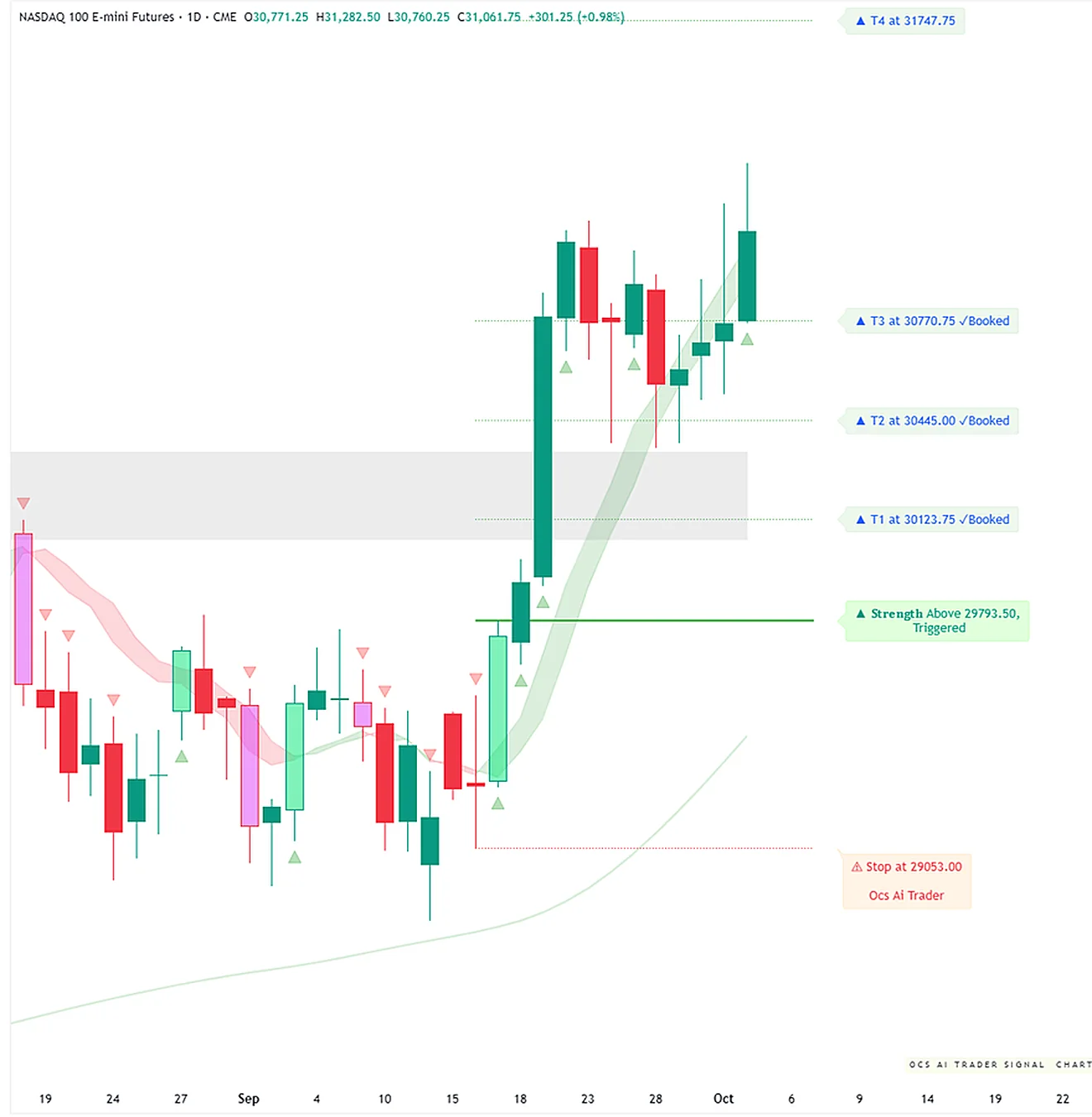
Education and market research only, not financial advice. Charts are OCS AI Trader readings at the time of writing and change with new bars.