The Warsh-HBM Pincer: AI’s Capital Hunger Meets a $105 Oil Reality
Thursday, May 14, 2026
The global macro landscape shifted violently today as the "Warsh Era" at the Federal Reserve officially began, coinciding with a 6.0% Producer Price Index (PPI) shock and a structural pivot within the Nasdaq’s heavyweights. While the headline AI narrative remains resilient, a sophisticated "pincer movement" is emerging: one arm is the hawkish transition of the Fed under Kevin Warsh, and the other is a $105 Brent crude price that is beginning to act as a stealth tax on the very compute-heavy infrastructure driving the market.
Today’s action is defined by a Great Bifurcation. On one side, we see the "Legacy Decay"—exemplified by Cisco’s massive workforce reduction and pivot away from traditional networking. On the other, we see "AI Inelasticity"—Microsoft’s staggering $37.5B CapEx commitment and Nvidia’s relentless climb. However, the non-obvious story lies in the "Twin Squeeze" of rising yields and energy costs, which is starting to transfer wealth from Cloud Service Providers (CSPs) to the specialized silicon and EDA (Electronic Design Automation) firms that sit at the top of the food chain.
The Four-Layer Impact Analysis
Layer 1: Direct Impacts — The "Warsh Era" and the Energy Spike
The confirmation of Kevin Warsh as Fed Chair has immediately re-priced the front end of the curve. With April PPI coming in at a scorching 6.0%, the market is no longer debating "if" rates will stay high, but "how much higher" they must go to break the back of energy-led inflation.
- Fixed Income & FX: The US Dollar Index (DXY) consolidated near 98.50, while the TLT (20+ Year Treasury Bond ETF) slipped to $84.80. The market is pricing in a regime shift toward aggressive balance sheet reduction.
- Energy: Brent Crude surged to $105.61, and WTI hit $101.03. This is no longer just geopolitical noise; it is a fundamental supply-side shock that is directly feeding into the PPI data.
- Equities: CSCO's restructuring signals the final surrender of legacy enterprise networking to the AI-first budget. This triggered an immediate capital rotation into NVDA (+2.29%) and AMD, as investors chase the "picks and shovels" of the new era.
Layer 2: Secondary Effects — The Margin Squeeze and EDA Resilience
As the direct impacts settle, the secondary ripple effects are hitting the "Middle Class" of the Nasdaq.
- Cloud Margin Compression: For the likes of MSFT, AMZN, and GOOGL, the cost of growth is skyrocketing. They are caught between the need for massive AI CapEx (validated by MSFT's $37.5B spend) and the soaring cost of the electricity required to run these data centers (driven by $105 oil/gas).
- The EDA/Equipment Surge: Because the AI hardware cycle is moving so fast, the design phase is becoming a permanent state of being. This benefits SNPS (Synopsys) and CDNS (Cadence). Unlike the hardware makers, these software firms don't have the same energy-intensity or inventory risk, making them a unique macro hedge within tech.
- Memory Bottlenecks: MU (Micron) is gaining significant pricing power. The demand for High Bandwidth Memory (HBM) for AI clusters is so inelastic that MU is effectively "taxing" the CSPs, transferring margin from the cloud giants to the memory fabs.
Layer 3: Macro Propagation — The EM "Twin Squeeze"
The combination of a hawkish Fed and triple-digit oil is the "worst-case scenario" for energy-importing Emerging Markets (EMs).
- Currency Stress: The USD/INR is testing the 95.80 level. While the NIFTY remains resilient due to trade optimism from the Trump-Xi summit, the underlying liquidity is thinning as Foreign Institutional Investors (FIIs) exit due to the "Twin Squeeze" of currency depreciation and rising input costs.
- Yield Curve Steepening: We are seeing a classic "bear steepener." Long-end yields are rising faster than the short end as the market prepares for the "Warsh Era" Fed to stop suppressing the term premium. This benefits the XLF (Financials) via Net Interest Margin (NIM) expansion but acts as a heavy discount-rate anchor on high-multiple SaaS stocks.
Layer 4: Non-Obvious Connections — The AI-Energy-Yield Feedback Loop
This is the "Alpha" layer where the most profound shifts are occurring:
- The Inflationary Feedback Loop: AI is inherently inflationary in the current environment. The massive CapEx required for AI drives extreme power demand, which keeps energy prices ($105 Brent) high. High energy prices drive PPI, which forces the Fed (Warsh) to keep yields high. Therefore, the more the Nasdaq spends on AI, the more it reinforces the high-interest-rate environment that devalues its own future cash flows.
- The Indian Energy-Tech Arbitrage: While most EMs are suffering, RELIANCE provides a unique hedge. It captures the refining margins from high oil prices while simultaneously building out the domestic AI data center infrastructure in India. This allows the Nifty to decouple from the broader EM stress.
- HBM as a Wealth Transfer Mechanism: We are witnessing a timing cascade. MU and NVDA will likely report record earnings for 1-2 more quarters before the "CapEx-induced margin erosion" fully shows up in the bottom lines of AMZN and GOOGL. The market is currently rewarding the spend, but it is ignoring the cost of the capital.
Security-by-Security Analysis
NVDA (Nvidia Corp)
- Price: $225.83 (+2.29%)
- Technical Status: RSI at 72.14 suggests it is entering overbought territory, but the MACD remains firmly bullish at 7.82.
- Options Flow: Massive volume in the $210 puts suggests institutional players are aggressively "flooring" their positions, essentially betting that any dip will be shallow.
- Causal Chain: Cisco’s pivot to AI infrastructure is a direct read-through for NVDA’s H200/B200 cycles. NVDA is the primary beneficiary of the "Legacy-to-AI" budget reallocation.
GOOGL (Alphabet Inc.)
- Price: $402.62 (+3.94%)
- Technical Status: A violent breakout today, clearing the 20-day SMA ($366.88) with ease. RSI at 75.78 is very hot.
- Options Flow: High call volume at the 290 and 340 strikes indicates a "chase" mentality.
- Causal Chain: Google is benefiting from the "Trade Optimism" sentiment, but it is the most vulnerable to the "Energy Tax" given its massive global data center footprint. Watch the $388 level (9-day EMA) for support on a pullback.
META (Meta Platforms)
- Price: $616.63 (+2.26%)
- Technical Status: RSI at 46.55 is neutral, suggesting it has more room to run than NVDA or GOOGL. It is currently oscillating around its 21-day EMA ($625.07).
- Options Flow: Heavy put activity at the 580-582.5 levels. This is "protective" flow, signaling that while the price is up, big money is hedging against a "Warsh-induced" valuation de-rating.
TLT (20+ Year Treasury Bond ETF)
- Price: $84.80 (-0.22%)
- Technical Status: RSI at 37.5 is approaching "oversold" territory. The price is hugging the lower Bollinger Band ($84.68).
- Causal Chain: The Warsh confirmation is the death knell for the "lower for longer" narrative. Until PPI cools, TLT will struggle to find a floor. $84 is the critical "line in the sand."
SNPS & CDNS (Synopsys & Cadence)
- Narrative: These are the "Yield-Proof" AI plays. As chip complexity increases to offset energy costs, the demand for EDA software becomes inelastic. They are the hidden beneficiaries of the bifurcation between legacy networking and AI silicon.
Historical Parallels
Today’s setup mirrors the 1999-2000 transition, but with a twist. In the late 90s, massive CapEx into fiber optics (the "legacy networking" of that time) met a Fed that was aggressively raising rates. The difference today is the Energy Overlay. We are seeing a combination of the 1970s oil shocks and the 2000s tech bubble. When energy costs and interest rates rise simultaneously, the "valuation ceiling" for high-growth tech historically drops by 15-20% even if earnings remain strong.
Outlook & Risk Matrix
| Timeframe | Sentiment | Key Levels to Watch | Catalyst |
|---|---|---|---|
| Short-term (1-5 Days) | Cautiously Bullish | NVDA $230, TLT $84, Brent $108 | Trump-Xi Summit headlines, JPY carry trade stability. |
| Medium-term (1-4 Weeks) | Volatile/Neutral | DXY 100, GOOGL $380, WTI $105 | Warsh's first official Fed speech, HBM supply data. |
The Bear Case
A "Warsh-Carry" volatility explosion. If the hawkish Fed drives US yields too high, the narrowing spread with Japan could trigger a violent unwind of the JPY carry trade. This would spike the VIX and cause a forced liquidation of the Nasdaq’s top 20, regardless of AI fundamentals.
The Bull Case
"AI Productivity Gains" materialize faster than the "Energy Tax." If Microsoft and Google can prove that AI is already reducing their internal costs enough to offset the $105 oil and 5% yields, the valuation de-rating will be avoided, and we move into a structural melt-up.
What to Watch
- USD/JPY at 155+: If the Yen continues to weaken despite the Warsh hawkishness, the "coiled spring" for a carry-trade unwind grows tighter.
- Brent-WTI Spread: A widening spread here favors RELIANCE and US-based refiners, acting as a hedge against global EM stress.
- HBM Pricing Power: Watch for any commentary from MU regarding supply bottlenecks. If HBM stays scarce, the wealth transfer from CSPs to memory makers will accelerate, pressuring MSFT and AMZN margins.
Bottom Line: The market is currently intoxicated by AI growth, but the "Warsh-HBM Pincer" is tightening the cost of capital and the cost of energy. The alpha is no longer in "Tech" as a monolith, but in the specific niches—EDA, Memory, and Energy-Hedged Industrials—that can survive a $105 oil reality.
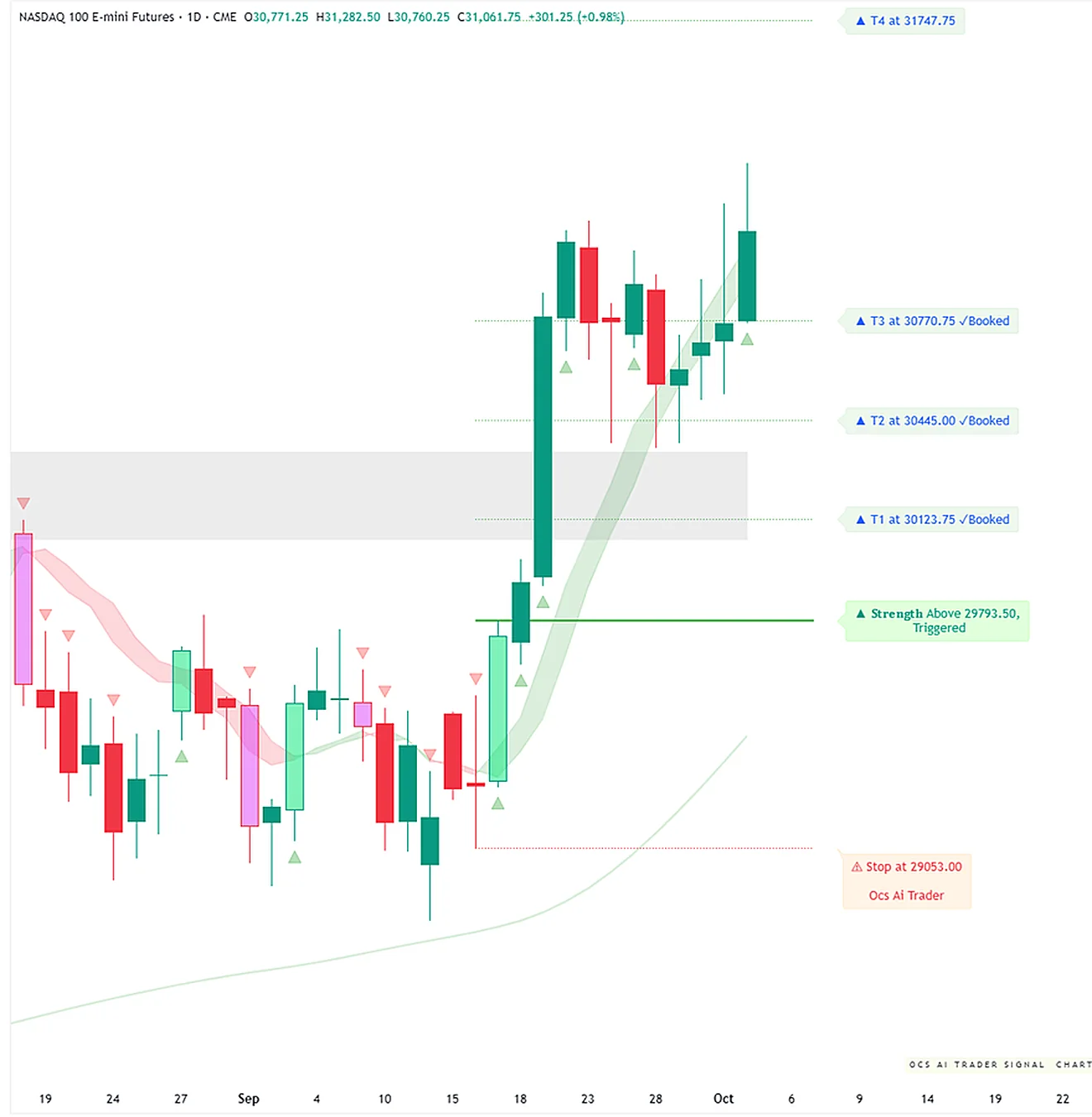
Education and market research only, not financial advice. Charts are OCS AI Trader readings at the time of writing and change with new bars.