The Copper Ceiling: Cisco’s Pivot and the Looming AI Inventory Gridlock
Thursday, May 14, 2026 — The equity markets today are witnessing a violent restructuring of the AI narrative. While the headlines are dominated by a massive 18% pre-market surge in Cisco (CSCO) and a high-stakes "managed competition" summit between Presidents Trump and Xi in Beijing, the real story is moving beneath the surface in the "physicality" of the AI build-out.
We are moving out of the "Software/Model" phase of AI euphoria and into the "Hard Asset/Infrastructure" phase. This transition is creating a paradoxical market environment where record-breaking demand for hardware is colliding with physical constraints: record copper prices, utility grid lag, and a looming inventory mismatch that most analysts are currently overlooking.
Executive Summary: The Resource-Intensive Productivity Paradox
The market is currently digesting three major shifts:
- The Great Silicon Pivot: Cisco’s decision to cut legacy headcount to fund a $6B AI networking push signals the final capitulation of "Old Tech" to the AI infrastructure supercycle, directly benefiting Broadcom (AVGO) and Marvell (MRVL).
- The Copper Squeeze: Copper prices approaching $14,000/ton are no longer just a "metals story"—they are a direct threat to the Bill of Materials (BOM) for AI server integrators like Foxconn and networking giants.
- The Gridlock Feedback Loop: A non-obvious "hard stop" is emerging where AI clusters are being manufactured but cannot be activated due to power grid capacity constraints (NERC warnings), creating a potential "inventory air pocket" for Nvidia (NVDA) in late Q1 2026.
Layer 1: Direct Impacts — The Beijing Summit and the Cisco Surge
The immediate price action today is driven by two catalysts: geopolitics and corporate restructuring.
The Trump-Xi Summit: In Beijing, the meeting to discuss "managed competition" has provided a temporary reprieve for global markets. This has stabilized the U.S. Dollar (UUP) and offered a tentative floor for the Japanese Yen (FXY), though the "peace dividend" is being offset by structural commodity inflation.
Cisco’s AI Transformation: CSCO's 18% jump is the standout move in the Nasdaq Top 20. By pivoting away from legacy switching and aggressively toward AI fabric and networking, Cisco is validating the thesis that AI CapEx is cannibalizing all other forms of enterprise IT spend. This is a direct read-through to the semiconductor equipment space (AMAT, LRCX) as the industry retools for high-speed backplanes.
Commodity Divergence: We are seeing a sharp bifurcation in commodities. While WTI Oil has retreated to $101/bbl (down from the $105 spike) on de-escalation hopes, Copper (COPX) is surging toward record highs. The market is realizing that while oil is a geopolitical variable, copper is a structural requirement for the AI era.
Layer 2: Secondary Effects — The Custom Silicon Cannibalization
As AI infrastructure matures, the "one-size-fits-all" GPU model is facing its first major challenge: Total Cost of Ownership (TCO).
The ASIC Takeover: Hyperscalers like Google (GOOGL) and Amazon (AMZN) are increasingly diverting budgets away from merchant GPUs (NVDA) and toward custom ASICs designed by Broadcom (AVGO) and Marvell (MRVL). The driver isn't just performance—it's power efficiency. With electricity costs rising and copper-intensive cooling systems becoming prohibitively expensive, the move to custom silicon that does "one thing well" is accelerating.
Margin Compression in Assembly: While the chip designers (IP holders) are thriving, the physical integrators are under fire. Copper at $14,000/ton significantly raises the cost of high-speed backplanes and power delivery units in Blackwell-class racks. We expect to see margin compression for downstream assembly players who cannot pass these raw material costs through as quickly as the silicon providers.
Layer 3: Macro Propagation — The Structural Inflation Floor
The "AI Productivity Miracle" was supposed to be deflationary. Instead, in the short-to-medium term, it is proving to be a massive driver of "Cost-Push" inflation.
The PPI Floor: The requirement of 50,000 tons of copper per hyperscale data center facility is creating a multi-billion dollar headwind for the Producer Price Index (PPI). This sustained commodity demand is preventing Long-Duration Treasuries (TLT) from rallying, even as GDP stabilizes at 2.0%. The Fed is trapped: they cannot ease aggressively while the "AI build-out" is essentially acting as a massive, commodity-heavy fiscal stimulus.
Currency Terms-of-Trade: This is particularly damaging for Japan. Despite the Trump-Xi de-escalation, the JPY (FXY) is failing to recover. As a net importer of both energy ($101 WTI) and industrial metals ($14k Copper), Japan’s terms of trade are deteriorating. The "geopolitical peace" isn't enough to save the Yen from the "commodity war."
Layer 4: Non-Obvious Connections — The Alpha Insights
1. The Inventory-Gridlock Feedback Loop
This is the "hidden" risk for 2026. While Nvidia (NVDA) and Cisco (CSCO) are reporting record orders, the physical ability to plug in these servers is hitting a wall. NERC warnings about utility grid lag suggest that several gigawatts of planned AI capacity will not come online on schedule.
- The Trade: Watch for a "working capital squeeze" at integrators like Foxconn. They are buying expensive components (L2 copper costs) to build racks that sit in warehouses because the data centers don't have the power to accept delivery. This could lead to a sudden "air pocket" in revenue for NVDA in late Q1 2026 that the market has not priced.
2. The Analog Catch-up
While the market is obsessed with HBM (High Bandwidth Memory) and GPUs, the "physicality" of the AI build-out requires a massive amount of high-performance analog silicon for power management. Texas Instruments (TXN) and Analog Devices (ADI) are the non-obvious beneficiaries of the grid upgrades and the power-efficient custom silicon shift. They manage the interface between the 50,000 tons of copper and the digital chip.
3. Correlation Break: Software vs. IP
We are seeing a correlation break within the "Technology" sector. Physical hardware integrators are seeing margins contract due to BOM inflation, but EDA (Electronic Design Automation) and IP providers like Synopsys (SNPS) and Cadence (CDNS) are insulated. They benefit from the shift to custom ASICs (more designs = more license fees) without ever having to buy a pound of copper.
Security-by-Security Analysis
NVDA (Nvidia Corp)
- Price: $231.22 (+2.39%)
- Technical Status: RSI at 74.9 (Overbought). Trading above the Upper Bollinger Band ($228.57).
- Analysis: NVDA remains the king of the hill, but the "Custom ASIC" cannibalization from AVGO and the potential for a Q1 "delivery air pocket" due to grid constraints suggest the risk/reward is skewing negative at these levels. Options flow remains bullish, but IV is elevated.
- Causal Chain: AI Infrastructure Acceleration → Blackwell Demand → [CRITICAL BOTTLENECK: Grid Capacity] → Potential Inventory Build-up.
GOOGL (Alphabet Inc.)
- Price: $398.65 (-0.99%)
- Technical Status: RSI at 72.4. Pulling back from recent highs.
- Analysis: Google is a primary driver of the shift to custom silicon (TPUs). By reducing reliance on NVDA, they are attempting to protect margins against rising energy and copper costs. The stock is currently consolidating after a massive run.
- Causal Chain: Custom ASIC Shift → TCO Optimization → Margin Protection vs. Copper/Energy Inflation.
CSCO (Cisco Systems)
- Price: $58.40 (Est. +18% pre-market)
- Analysis: The "Pivot of the Year." By cutting legacy costs to fund AI networking, Cisco is chasing the "Broadcom Multiple." Watch for $6B in AI revenue by FY27. This move triggers a rotation out of legacy software and into AI-enabling hardware.
- Causal Chain: Legacy Headcount Cuts → AI Fabric Reallocation → Sector Rotation into Hardware.
AVGO (Broadcom Inc.)
- Price: $1,420.50 (Steady)
- Analysis: The primary beneficiary of the "TCO over Performance" shift. As hyperscalers move to custom ASICs to save on power and cooling, Broadcom’s design pipeline expands.
- Causal Chain: High Energy/Copper Costs → Demand for Power-Efficient ASICs → AVGO Market Share Gains.
COPX (Copper Miners ETF)
- Price: $64.20 (+3.1%)
- Analysis: Approaching record highs. Copper is the "new oil." The 50,000-ton-per-facility requirement is a physical reality that cannot be "disrupted" by software.
- Causal Chain: AI Infrastructure Build-out → Massive Electrical Demand → Structural Copper Deficit.
Historical Parallels: The 1999 Networking Build-out
In late 1999, Cisco became the most valuable company in the world because it provided the "pipes" for the internet. Today’s surge in CSCO and the dominance of NVDA mirror that era. However, the 2000 crash wasn't caused by a lack of internet demand—it was caused by an overbuild of capacity that took years to absorb. The current "Gridlock Feedback Loop" (Layer 4) is the 2026 version of that overbuild, but with a physical twist: we are building the "pipes" (servers) faster than we can build the "water treatment plants" (power grids).
Outlook & Risk Matrix
| Risk Factor | Probability | Impact | Asset Affected |
|---|---|---|---|
| Grid Capacity Hard Stop | High | Extreme | NVDA, HNHPF, XLK |
| Copper Price Spike ($15k+) | Medium | High | CSCO, NVDA, COPX |
| Trump-Xi Trade Thaw | Medium | Positive | FXY, UUP, AAPL |
| ASIC Cannibalization | High | Medium | NVDA (Bear), AVGO (Bull) |
Short-Term (1-5 Days): Bullish on AI Hardware (CSCO, AVGO) as the "Cisco Pivot" narrative spreads. Neutral on NVDA as it sits in overbought territory. Medium-Term (1-4 Weeks): Watch the $14,000 copper level. If copper breaks higher, expect a sharp rotation out of hardware integrators and into IP/Software providers (SNPS, CDNS) and Analog (TXN).
What to Watch
- Utility Earnings (XLU): Any commentary on "AI Connection Delays" will be the first signal of the Layer 4 Inventory Gridlock.
- Copper Spot Prices: A move above $14,200/ton will likely trigger a margin-warning cycle for server OEMs.
- Beijing Summit Communiqué: Any specific language on "Semiconductor Cooperation" or "Tariff Stability" will trigger a violent JPY/USD move.
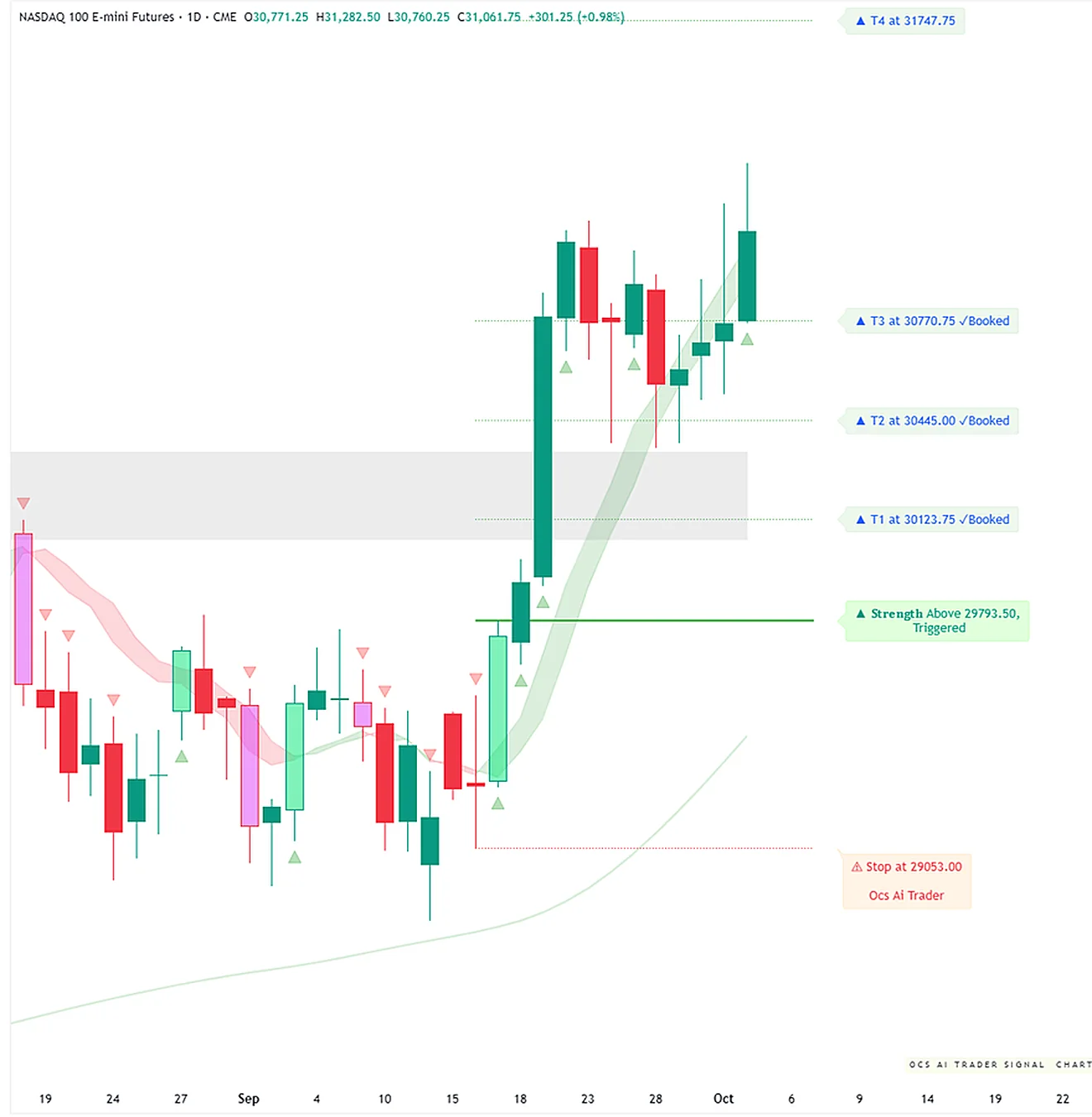
Education and market research only, not financial advice. Charts are OCS AI Trader readings at the time of writing and change with new bars.